Operator Qualification
You Can Prove in a Regulatory Inspection.
HintVR replaces the multiple-choice test with a 1:1 digital twin of your manufacturing environment. Operators are qualified when they can demonstrate the correct procedure, under pressure, in sequence, without prompting.
A Passed Test Is Not
a Qualified Operator.
Across regulated pharmaceutical manufacturing, Operator Qualification is documented on paper, assessed through multiple-choice tests, and signed off by a supervisor who watched the operator once during training. Then that operator goes to the floor. And 80% of process deviations are still attributed to human error. The question is not whether the operator passed the test. It is whether the operator can perform the procedure correctly, every time, on every shift, under real conditions. HintVR answers that question with data.
"They passed the assessment."
A multiple-choice test measures recall under low-stakes conditions. It does not measure whether an operator can correctly sequence a line clearance, respond to an equipment alarm mid-procedure, or maintain aseptic technique through an extended intervention. It measures whether they studied. HintVR measures whether they can perform.
"They were signed off by a supervisor."
Supervisor sign-off is the most widely used OQ evidence in the industry, and the hardest to defend under inspection. It relies on the supervisor's presence, their consistency, and their willingness to pass someone they trained themselves. It produces documentation without demonstrable competency. HintVR produces session records, step-level completion data, and deviation rates that don't depend on anyone's judgment call.
"Training records are in the LMS."
Completion is not competency. An LMS records that an operator opened a module, watched a video, and clicked through to the end. It does not record that they performed the correct valve sequence, recognised the alarm condition, or completed the procedure within the required time. HintVR writes the difference between what was taught and what was actually done, to your LRS, your LMS, and your QMS.
Qualification Based on What Operators Can Do.
Not What They Can Remember.
HintVR creates a fully interactive 1:1 digital twin of your manufacturing environment. Operators run real procedures (setup, operation, line clearance, deviation response, shutdown) in the exact environment they will work in. Every step is scored. Every deviation from SOP is logged. Qualification is earned by demonstrated performance, not accumulated attendance.
Demonstrate, Don't Memorise
The operator is placed inside a photorealistic replica of your cleanroom, filling line, or manufacturing bay. They must perform each procedural step in the correct sequence, using the correct technique, within the correct parameters. There is no answer key. There is no option B. There is only the procedure, and whether they can execute it.
Score Every Step, Not Just the Outcome
HintVR captures interaction data at the step level: which actions were taken, in which sequence, at what time, with what accuracy. An operator who completes a line clearance but skips the intermediate cleaning verification does not receive a passing score, regardless of the final outcome. The scoring logic mirrors your SOP, not a generic competency rubric.
Records That Stand Up to Inspection
Every completed session generates a timestamped, user-attributed qualification record written as an xAPI statement. Step-level scores, deviation counts, time-on-task, and attempt history are available for any operator, any procedure, any date. When an FDA inspector asks for OQ evidence, the answer is two clicks, not a conversation with the training manager.
Know Exactly Which Operator Is Ready for the Floor.
Before They Step on It.
The Deployment Readiness Index (DRX) is HintVR's operator qualification score. It is not a completion percentage. It is a composite performance measure that tells you, with documented evidence, whether a specific operator is qualified to perform a specific procedure on a specific line, or whether they need another practice cycle first.
Procedural Accuracy
Did the operator execute every step in the correct sequence, without skipping or reversing critical actions? Weighted by the risk classification of each step: a skipped equipment check scores differently from a missed documentation step.
Deviation Response
When an alarm fired or an unexpected condition was injected, did the operator respond correctly? Did they escalate appropriately? Did they document the event? Deviation response is the hardest competency to assess on paper and the easiest to assess in simulation.
Time on Task
Did the operator complete each phase of the procedure within the expected time window? Operators who take significantly longer than the SOP baseline carry a higher error risk in real production conditions, and the DRX flags this before it becomes a batch event.
Consistency Across Attempts
A single strong performance is not qualification. DRX tracks performance across multiple simulation runs and scores the consistency of execution, because an operator who performs well once but variably across attempts is not yet a qualified operator.
DRX gives your QA team a defensible, evidence-based answer to the question regulators actually ask: not "Was this operator trained?" but "Was this operator qualified, and how do you know?"
Every Step. Every Deviation.
Captured in Real Time.
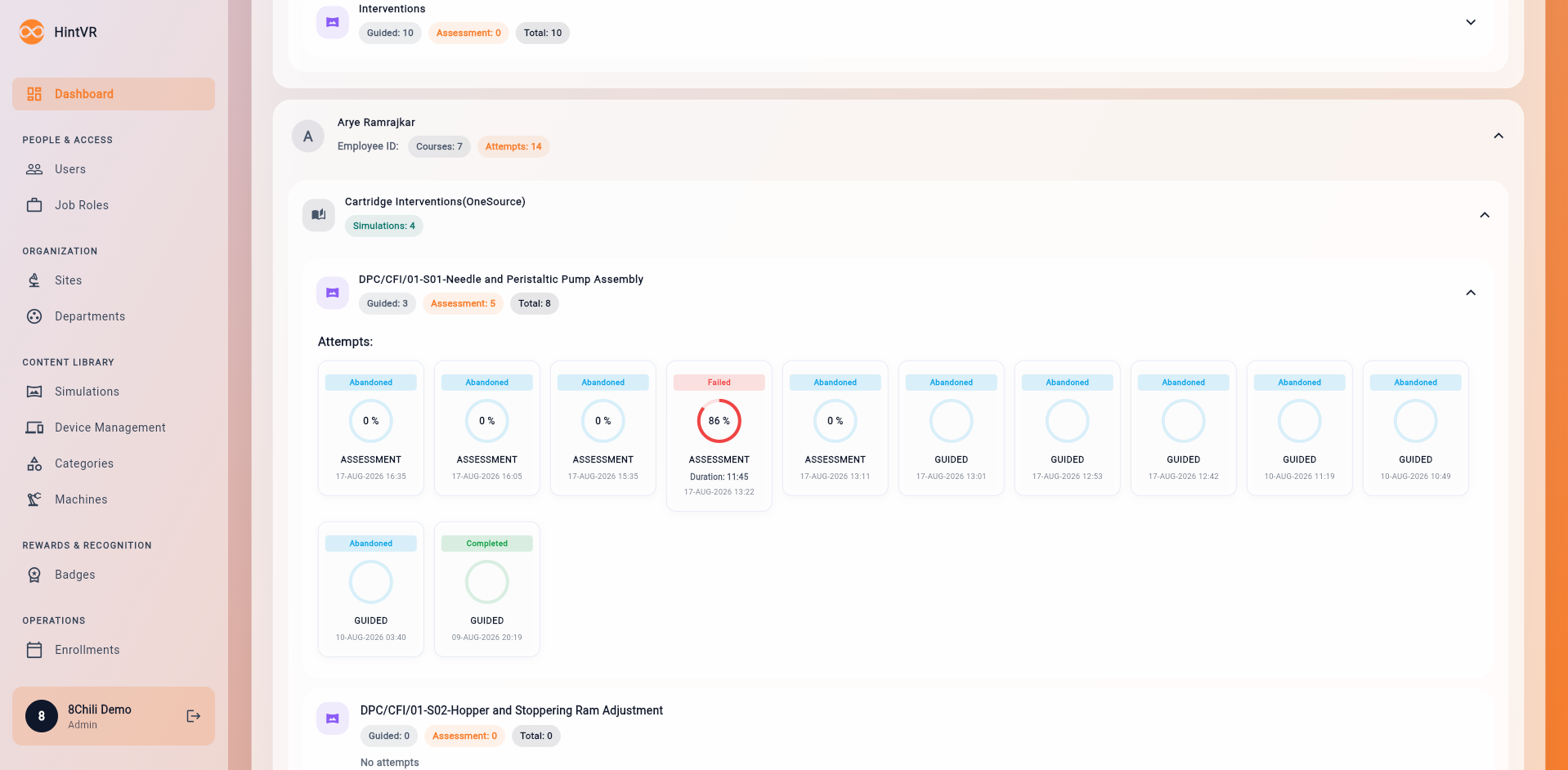
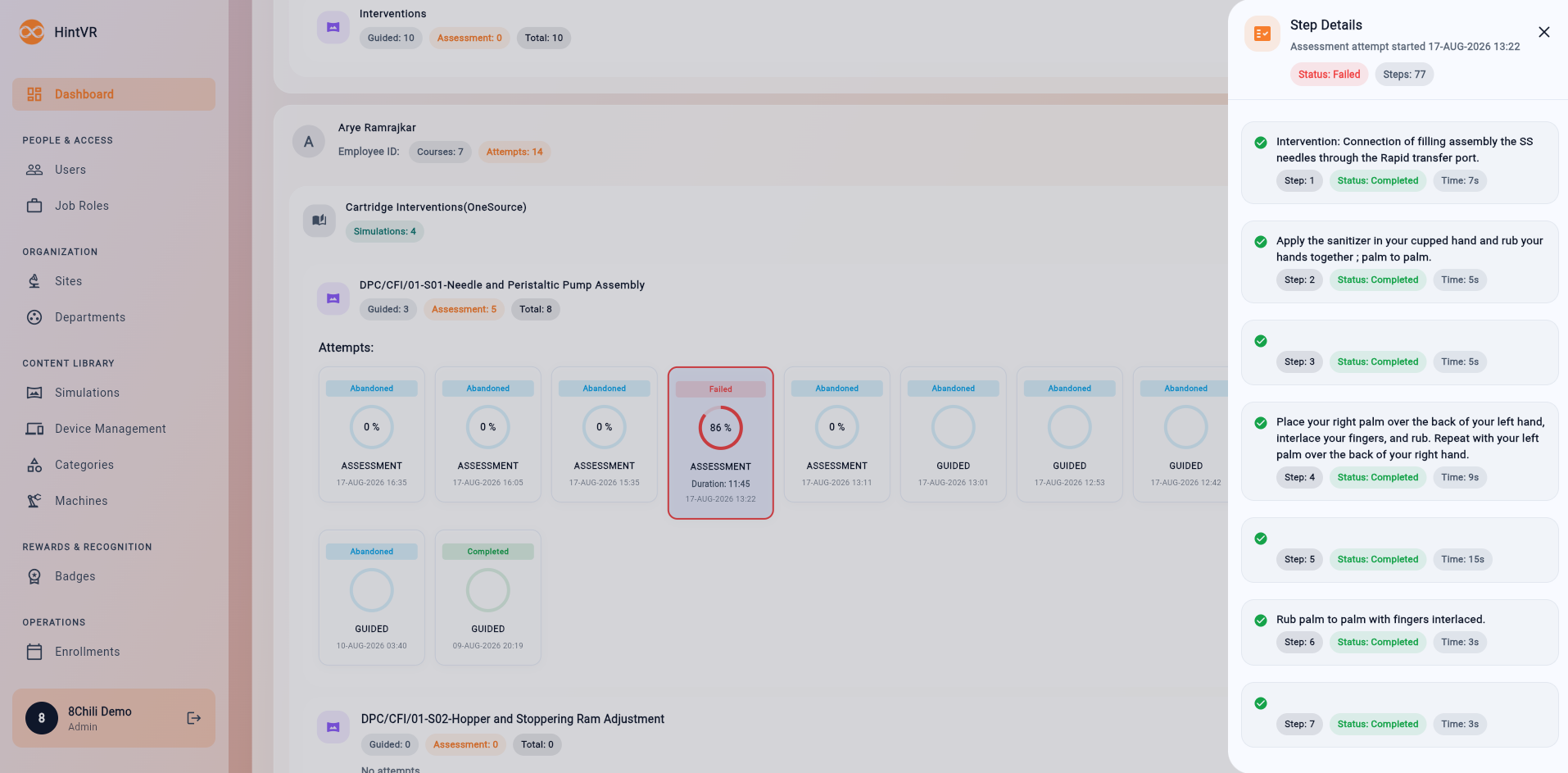
The HintVR dashboard gives QA teams complete visibility into every assessment attempt. See which steps were completed, which were skipped, where hints were taken, and how scores evolved across multiple attempts, all without a single paper record.
From Your SOP to a Qualification-Ready
Simulation in Weeks.
Two distinct modes. One for building competency. One for proving it.
Ingest Your Documentation
Share your SOPs, P&IDs, equipment specifications, and facility layout. Our team ingests every procedural step, parameter tolerance, interlock condition, and alarm state. The simulation is built from your validated documentation, so the procedure operators practice is the exact procedure they will be qualified against.
Build Your Digital Twin
Our engineers construct a photorealistic 1:1 model of your manufacturing environment. Every HMI panel, valve position, instrument reading, and physical interlock is modelled to your engineering specifications. Typical build timeline: 6–10 weeks from documentation intake to first live session.
Train in Guided Mode
LEARNGuided Mode is where operators build procedural competency. The simulation walks the operator through each step with contextual cues, on-screen prompts, and real-time feedback when a step is performed incorrectly. Operators can repeat each procedure as many times as they need at their own pace, on any shift, without requiring a trainer or supervisor to be present.
This is not passive e-learning. The operator is physically performing each action inside the digital twin, opening valves, responding to HMI states, handling equipment in sequence. Guided Mode builds the muscle memory that a classroom cannot.
When to use: New hire onboarding · SOP refresher training · Introduction to new equipment before go-live
Qualify in Assessment Mode
ASSESSAssessment Mode removes all guidance. No prompts. No hints. No second chances on critical steps. The operator must perform the complete procedure (correct sequence, correct technique, correct parameters) without assistance. The simulation records every action: what was done, what was skipped, what was done out of sequence, and how long each phase took.
This is the qualification event. The DRX score is generated here. An operator who passes Assessment Mode has demonstrated that they can perform the procedure independently, not that they followed instructions correctly when told what to do next.
When to use: Initial operator qualification · Periodic requalification · Post-CAPA reverification · New line qualification · Multi-site competency standardisation
Issue Inspection-Ready Qualification Records
Qualification records are generated automatically at the end of every Assessment Mode session: timestamped, user-attributed, step-level completion data written as xAPI to your LRS. DRX scores, deviation counts, time-on-task, and full attempt history are available for any operator, any procedure, any date. Exportable to your QMS for CAPA linkage and periodic review. Every record is 21 CFR Part 11 compliant from the moment the session ends.
A Guided Mode completion record says: this operator was trained on this procedure.
An Assessment Mode completion record says: this operator demonstrated they can perform this procedure independently, without assistance, to the standard defined in your validated SOP.
Only one of those answers satisfies the question an FDA inspector is actually asking.
Every Procedure Your Operators
Must Be Qualified On.
Aseptic Interventions
Train and qualify operators on Grade A isolator entries, glove integrity checks, and sterile interventions without risking contamination of a single live batch. Practice sequences that cannot be rehearsed on a live line, because the consequences of an error are too high.
Line Clearances & Changeovers
The highest-frequency deviation trigger in OSD and parenteral manufacturing. Operators are qualified on the complete line clearance sequence, including intermediate checks, documentation steps, and supervisor notification points, before they perform it on a live line.
Batch Setup & Equipment Operation
From RMG granulation startup to filling machine calibration, operators run the full setup sequence in the digital twin of the specific equipment on your floor. Not a proxy model, your equipment, your parameters, your SOP. Includes handling of rare deviation conditions, sensor failures, and equipment alarm responses.
CAPA Retraining & Reverification
When a deviation event triggers a CAPA action requiring operator retraining, HintVR delivers the reverification session, and issues a new qualification record, as documented evidence of corrective action. Your auditor sees not just the CAPA, but the evidence that it worked.
The Cost of Unqualified Operators
Is Already in Your P&L.
These are not projections. They are documented outcomes from pharma and biopharma manufacturers who have replaced traditional OQ with performance-based VR qualification.
Of process deviations in manufacturing attributed to human error
In productivity lost per hour of unproductive labour by low-skill workers each week
Average time to full skill mastery in regulated manufacturing using traditional methods
Reduction in new operator time-to-qualification (Takeda, 10,000 VR sessions annually across 13 sites)
Reduction in production deviations following VR-based operator qualification rollout (Takeda)
"With 10,000 VR trainings conducted each year, training time for new employees can be reduced by up to 30%, while deviations can be reduced by up to 5%."
Takeda Pharmaceuticals
"The customised VR platform has the potential to reduce training costs for a pharma operation by up to €1,000 per week."
TU Dublin / BioPharmaChemSkillnet
Every Qualification Record Is
Inspection-Ready from Day One.
HintVR was not designed for general corporate training and adapted for pharma. It was built from the ground up for manufacturers operating under FDA, EMA, and WHO GMP frameworks, where every training record is a regulatory document.
21 CFR Part 11
Every session record carries a unique user identifier, precise timestamp, step-level completion data, and DRX score. Records are tamper-evident and electronically signed via Adobe Acrobat Sign integration. Fully audit-ready without manual export or reformatting.
EU GMP Annex 11
System validation documentation available in IQ/OQ/PQ format following the V-model lifecycle. GAMP 5 risk categorisation applied. ALCOA+ data integrity principles built into the session record architecture.
xAPI / SCORM
Every operator interaction captured as an xAPI 1.0.3 statement written to your LRS. SCORM 1.2 packages available for existing LMS platforms including Cornerstone, SAP SuccessFactors, Veeva Vault Training, and Docebo.
Computer System Validation
Our 12-document CSV suite (User Requirements Specification, Functional Specification, Traceability Matrix, and Test Protocols) is available to qualifying enterprise customers to support your internal validation programme under GAMP 5.
150+ Pre-Built SOP Twins.
Qualified Operators in Weeks, Not Months.
You do not need to start from scratch. 8chili's module library covers the most common regulated manufacturing procedures across OSD, Parenteral, API, and Laboratory operations. Every module is built to pharmaceutical GMP standards and customisable to your facility's specific SOPs and equipment configurations.
Oral Solid Dosage
Granulation, blending, compression, coating, line clearance, and packaging operations. Includes RMG, fluid bed dryer, tablet press, and blister line modules.
Parenteral & Sterile
Aseptic filling, vial and syringe operations, lyophilisation, Grade A isolator interventions, gowning qualification, and CIP/SIP cleaning validation.
API & Chemical Manufacturing
Reactor operations, material transfers, weighing and dispensing, potent compound handling, and clean-in-place procedures.
Laboratory & QC
HPLC operation, dissolution testing, sampling procedures, environmental monitoring, and instrument calibration qualification.
HintVR Is Running Qualification Programmes
Across India, the US, and Beyond.
Lupin
OSD and Parenteral
Multi-site deployment across OSD and Parenteral manufacturing. Operators qualifying on granulation, compression, and line clearance procedures across mfg sites using a single shared digital twin, enabling consistent qualification standards across geographies.
→ Read the full storyCIPLA
Parenteral & OSD
MDI, DPI, OSD and Parenteral VR modules live across multiple CIPLA sites in India and USA. 250+ qualification sessions completed across sites. US Training heads report significant opportunity in reduction of supervised observation time required before operators are cleared for independent operation.
→ Read the full storyStrides Pharma
Measuring Operational Efficiency
Comprehensive VR qualification programme deployed across regulated manufacturing over the last 3 years. At Strides KRSG plant 95% of the machines are twinned making VR OQ an integral part.
→ Read the full storyThe People Who Run These Facilities
Have One Thing to Say.
"8chili's obsession with customer success and their ability to deliver quality at speed is unmatched."
"The speed with which 8chili rebuilt our capability was the difference between a line shutdown and a recovery."
Hardware-Agnostic.
Integrated Into How You Already Work.
Hardware Support
- Meta Quest Series (2, 3, Pro), Meta Business Suite managed deployments
- HTC VIVE XR Elite Business Edition, recommended for cleanroom-proximate use
- Pico 4 Enterprise
Software Infrastructure
- SCORM 1.2 / xAPI 1.0.3 for LMS and LRS sync
- 21 CFR Part 11 compliant session records with e-signature via Adobe Acrobat Sign
- EU GMP Annex 11 / GAMP 5 IQ/OQ/PQ validation documentation available
- VIVE Business DMS MDM for remote headset fleet management
- Native integration with SkillsForge, 8chili's Digital Workforce OS
See Your Facility. Qualify Your Operators.
Defend Your Records.
Every engagement starts with a discovery call specific to regulated manufacturing. We map your highest-risk OQ gaps, identify the three procedures most likely to trigger a 483 observation, and show you what your qualification programme looks like when it is built on demonstrated performance, not documentation.